

Good riddance to non-competes
I love that the FTC just banned non-competes, as everyone expected they would. Normally, I’m in favor of small government and fewer regulations, but this is one where I think the government has a legitimate interest in setting up guardrails to a free market.
We started off at Return Path years ago with a standard and fairly benign non-compete because they were standard. But once California banned them and then we started doing business internationally in countries where they were illegal or not customary, we realized it was unfair to treat some employees different than others, so we got rid of them entirely and reverted to the common denominator. We don’t have them at Bolster.
Restricting employees in terms of where they can go work when they leave you is unfair and immoral, in my view. Just because you train an employee and invest in them doesn’t mean you own them. That investment was an exchange for the work that person did for you. There is no such thing as indentured servitude in this country. If you want to keep your employees from leaving you, treat them well and pay them well.
The pendulum has swung way too far on this one, and it was high time for a correction. When the Wall Street Journal says that “Sales staff, engineers, doctors and salon workers are among the most common types of workers affected by litigation of noncompete clauses…in 2022” that makes me sick to my stomach.
Making sure former employees can’t specifically harm you after they leave is a different story.
Some restrictive covenants for a limited period of time for former employees are totally fair. Customer and employee non-solicits for a year – no problem. Non-disclosure of confidential information, trade secrets, and know-how – gotcha. But “you can’t go work at that company because they compete with us” doesn’t work for me.
There are some limited circumstances where non-competes are fair, moral, and make sense. They are more or less relegated to very senior and/or highly specialized people who make a ton of money and large equity stakes in companies who can’t to go to competitor and perform any job at their level without pulling over customer relationships, employee relationships, and know-how and trade secrets. That’s why people at hedge funds and investment banks have “garden leave” where the incoming firm has to pay them to sit on the sidelines for a year before joining. Hopefully those exclusions will remain allowable when all is said and done here.
But by and large, I say good riddance to non-competes. They’re about as American as the metric system and hereditary dictatorships.
Decisions
Happy Leap Day!
One of the better books I’ve read in the last 6 months is James Clear’s Atomic Habits: An Easy & Proven Way to Build Good Habits & Break Bad Ones, which provides a great framework around habits. It’s worth a read, whether you’re talking about business habits/routines or personal ones. This isn’t a book review, but quickly while I have you – here’s a summary of his “laws”:
HOW TO CREATE A GOOD HABIT
The 1st Law: Make It Obvious
The 2nd Law:Make It Attractive
The 3rd Law: Make It Easy
The 4th Law: Make It Satisfying
HOW TO BREAK A BAD HABIT
Inversion of the 1st Law: Make It Invisible
Inversion of the 2nd Law: Make It Unattractive
Inversion of the 3rd Law: Make It Difficult
4th Law: Make It Unsatisfying
Add to that my other key takeaway, which is that you have to tie habits not just to outcomes but to identities, and…great book! Anyway, my story today is about decisions, and I’m going to quote James Clear’s email newsletter here, at the end of which he credits Tim Ferriss for sparking his thinking. So this is, what, third hand thinking. But it’s a great way to think about decisions, something I’ve written about a lot, including here.
I think about decisions in three ways: hats, haircuts, and tattoos.
Most decisions are like hats. Try one and if you don’t like it, put it back and try another. The cost of a mistake is low, so move quickly and try a bunch of hats.
Some decisions are like haircuts. You can fix a bad one, but it won’t be quick and you might feel foolish for awhile. That said, don’t be scared of a bad haircut. Trying something new is usually a risk worth taking. If it doesn’t work out, by this time next year you will have moved on and so will everyone else.
A few decisions are like tattoos. Once you make them, you have to live with them. Some mistakes are irreversible. Maybe you’ll move on for a moment, but then you’ll glance in the mirror and be reminded of that choice all over again. Even years later, the decision leaves a mark. When you’re dealing with an irreversible choice, move slowly and think carefully.
As someone who loves hats, has had (and seen) his fair share of bad haircuts, and has a tattoo, I can totally relate!
Book Short: Less is More
Subtract: The Untapped Science of Less, by Leidy Klotz is a great read, and in concert with the philosophy of the book, this will be a short blog post.
The book’s basic premise is that less is more, addition by subtraction. The author’s examples range from the genius of the Strider Bike (bike without pedals) that allows 2-year olds to ride bikes to the Embarcadero in San Francisco. Many people don’t remember that that road used to be called the Embarcaro Freeway, a massive, ugly, two-tiered structure that blocked out the views and waterfront, and that the opportunity to tear down the whole thing following the massive 189 earthquake left San Francisco with a much simpler, beautiful, liveable waterfront by the Ferry Terminal.
There are many great takeaways in the book as well as an action plan for how to think about subtracting AND adding, not just adding, which is the normal reflex for humans, and I’d add ESPECIALLY for entrepreneurs!
We put these principles into action a couple weeks ago at Bolster. When we were crafting our 2024 plan, we worked methodically as a leadership team to reduce. We cut out words, but we also cut out topics and strategic initiatives. The end product was less than 50% the size (word for word) of the 2023 plan, and I think it’s much crisper, more memorable, and more actionable for our team than last year’s.
Hopefully over time, we will find more occasions to do less.
I’ll close with two of my favorite quotes, both of which were in the book. One is by Mark Twain, which is “I didn’t have time to write a short letter, so I wrote a long one instead.” The other is by Lao Tzu, which is “To attain knowledge, add things every day. To attain wisdom, subtract things every day.”
Sometimes less takes more time. But it’s almost always more valuable.
How I Engage with the CBDO
(Post 4 of 4 in the series on Scaling CBDO’s- other posts are, When to hire your first Chief Business Development Officer, What does Great look like in a Chief Business Development Officer and Signs your Chief Business Development Officer isn’t Scaling)
Other than the weekly executive meeting, your day as a CEO rarely has an entry of “meet the CBDO.” Because of the infrequency of deals it’s critical to engage with the CBDO with a regular cadence so that when something does come up you’re not getting to know each other again. Anyway, a few ways I’ve typically spent the most time or gotten the most value out of CBDOs over the years are:
One way to engage with the CBDO is to make ecosystem maps together. It’s important for you and the CBDO to understand exactly what ocean you’re swimming in, which other fish are swimming nearby, and which ones are sharks you need to watch out for. This understanding is what can make or break the CBDO role and it is vital that you, as CEO, engage with and help shape that understanding since you’ll have specialized knowledge of some of the other players, their CEOs, and their strategies. The ecosystem map is actually a fun thing to create and not only does it lead to better clarity about where you’re at and where you could go, it also aligns you and the CBDO on a deeper, strategic level.
While you can plan out the ecosystem mapping activity, a lot of the engagement I have with the CBDO is sporadic, unplanned, and spontaneous. The deal world is intense and unpredictable. When you’re working on a deal you may be talking to your CBDO 20 hours a day. When it’s business as usual, you may go weeks without deep interaction. So unlike the other executives, the time you engage with your CBDO will be compressed into highly intense time frames.
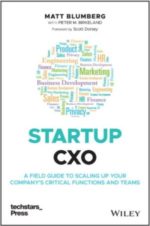
A third way I engage with the CBDO is in-market and in-transit. As with the CRO, I spend time extensively with the CBDO since we are likely going to the same place at the same time a few times a year. Since the essence of the job as a CBDO is to be a trusted ambassador on all fronts, as Ken identified correctly in his section of Startup CXO, the CEO has to constantly be engaging the ambassador on the organization’s most current thinking, positioning, forward-looking strategy. Over the life of Return Path (and currently at Bolster), there’s no question that I spent the majority of my “planes, trains, and automobiles work time” with Ken.
(You can find this post on the Bolster Blog here).
The Dowry
Here’s one to keep in mind – we did this a few times at Return Path, and I was just reminded of it when I was coaching another founder who is doing the same thing right now.
Sometimes when you’re doing a strategic acquisition and it’s an all-stock deal, you can insist as a term of the acquisition that the target company’s investors invest more capital into your company.
That’s right, not only do you not have to put cash OUT for the deal, you’re getting additional cash IN. Think of it as a contemporary corporate version of the dowry.
Why would the cap table of the target company agree to this? Here are a few reasons:
- you’re in a strong enough negotiating position – best home for the business, best chance of the target company investors getting a return
- the target company investors have more dry powder and want to double down – they love your vision for the combined company
- you’re only offering the target company investors common stock in the deal, and they are pushing hard to get preferred
The Dowry is not something you can get to with every deal, and you might not need it. But think of it as a tool in the M&A/financing tool belt.
Signs your CBDO isn’t scaling
(This is the third post in the series… The first one When to Hire your first CBDO is here, and What does Great Look Like in a CBDO is here).
The metrics for understanding whether or not your CBDO is scaling differs from other functions like Sales, People Ops, Customer Service, and Finance because throughout the scaling process the CBDO team is likely to be small. So how do you know if your CBDO is scaling if they’re essentially the same size regardless of what the rest of your company is doing? I have found that CBDOs who aren’t scaling well past the startup stage are the ones who typically operate in the following ways.
First, a CBDO who isn’t scaling is throwing everything over the wall internally. Some people in this role, especially ones who have been long-time bankers or consultants and who are used to having armies of junior resources at their disposal, don’t like or don’t know how to roll up their sleeves and handle execution. The reality is that in-house BD teams are very small, frequently only one or two people, and the person leading the team needs to do a lot of the work, not just the planning and external meetings.
Second, if your CBDO has an over-reliance on outside advisors like bankers and lawyers, that’s a sign that they’re not scaling. The whole reason companies in-source this role is that they expect to have a fair amount of activity — developing partnerships, executing a roll-up strategy, building out the channel. While external advisors are critical for a number of those activities, knowing when, and when not to hand things off, especially when the advisor bills by the hour, is critical.
A third sign is if your CBDO is focused on quantity rather than on quality. I have found that there are times when it’s important to be able to show a large number of partners, for example if you’re trying to run an industry-wide coalition or program. And also there are times when it’s important to show a lot of deals in the pipeline, for example if you’re pitching an M&A roll-up strategy to a potential financial sponsor. But you know your CBDO is in trouble when the focus becomes the number of deals in the pipeline as opposed to making sure there are a few larger ones with deeper, multi-faceted relationships that will move the needle on the business objectives. Your CBDO should be helping to develop the ecosystem and this is done a lot easier by finding and working with the gems rather than developing all sorts of channel partnerships or deals that look good on paper, or get good PR, but don’t actually move the business forward.
Fighting Confirmation Bias
I was mentoring a first time founder the other day who asked me, “How do you know what advice to follow and what advice not to follow?” (For the record, it’s a little ”meta” to answer that question!). I talked about looking for patterns and common themes in the advice from others and exercising judgment about how to pick and choose from competing pieces of advice. But then he asked me how I fight confirmation bias when I’m exercising judgment and incoming advice.
Fighting confirmation bias is both incredibly important and incredibly difficult, and I’d never articulated my thoughts on that before, so I thought I’d do that here.
The way you have to train yourself to fight confirmation bias is to develop a routine or muscle around receiving a piece of advice that you don’t like. While the normal response is to dismiss it or argue against it, the muscle you have to build is to react to advice you don’t like by taking a beat and asking yourself, “Why don’t I like this advice?”
Is it that you think it’s factually wrong or is given on incomplete information? Is that it just disagrees with your world view? Or is it that you just hope it’s not true because it would mean bad things for you or your company? If it’s the latter, or something like it, it’s time to sit down and analyze the advice in the context of the question you asked. What happens if it is true? Why would it be true?
Under the headline of “hope is not a strategy,” doing that work gets you to a better place, because it’s in that work, in pausing to answer the question “Why don’t I like this advice,” that the hard work of fighting confirmation bias happens.
What Does Great Look Like in a Chief Business Development Officer?
(This is the second post in the series….the first one When to hire your first CBDO is here)
One of the tricky things about finding a great CBDO is that the role is fairly nuanced and there’s not a degree a person can get in “business development.” So you’re left with searching for someone based partially on experience, reputation, and alignment with your company culture and goals. But over the course of my career I have figured our what “great” looks like for the CBDO and I’m confident that what worked for us at Return Path and Bolster will work for any startup.
First, a great CBDO should have a good balance of the three core components Ken Takahashi outlined in his section of Startup CXO. Those three components include partnerships, M&A, and strategy. Even if a person started their careers out as an investment banker or a management consultant, or some other specialized field, they should still be able to bring all three competencies to bear to help further the goals of their team – to optimize the company’s place in the ecosystem. A one-trick pony will get you nowhere in the ecosystem and the CBDO needs to be a competent generalist in a wide range of skills.
Second, a great CBDO will look at business strategy first before trying to solve a problem because a solution that doesn’t advance the strategy will fail. It’s not enough to be able to develop a strategy, the great CBDOs will return to that strategy constantly. If a CBDO is highly skilled at one of the components, say M&A, they are likely to risk becoming the the proverbial hammer in search of a nail and they will put a primacy on M&A deals. The strategy acts as a safeguard to pursuing something because the CBDO wants it amd instead helps them pursue something that fits with the overal strategic drivers of the business. So, strategy is king in the CBDO world.
Third, a great CBDO will see the whole system at a company, not just one thing. They’ll see product (and all of its components) as well as go-to-market (and all of its components). Like the CEO, CFO, and Chief People Officer, the CBDO needs to have a holistic approach to everything and not only be closely aligned with the market-facing organizations.
You can find this post on the Bolster Blog here.
Family vs. Team?
I used to describe our culture and our employees and our leaders at Return Path as a family.
That was a mistake. It was just plain wrong. It served us well in some respects, but it bit us in the ass on others.
Great groupings of people at work are teams, not families. You can have a highly functional family. But you don’t have high performing families. Work teams need to be high performing.
Here’s what I mean.
The family metaphor worked well at Return Path around the principles of caring for people and lifting each other up. Those elements of a culture are absolutely critical. I don’t regret them for a minute.
But the downside of that metaphor is that families by definition stay families. Sure, spouses can get divorced, but usually not after years of trying to make it work. And kids and parents can’t stop being relatives. Families also don’t typically have metrics and have a structural impetus to improve how they relate to each other, or to some kind of tangible output.
The practical problem with the family metaphor comes down to holding on to people too long when those people aren’t performing well. While I am a big believer that past high performance is both an indicator of future high performance and earns you as an employee a little extra grace when something goes wrong, those things can’t be absolute in business, and they have a clock on them. High performing businesses go the extra mile for their people when their people are going through a rough patch in their lives, and they should be willing to invest in coaching and development when their people need a boost or some kind of corrective action. But not indefinitely.
So even with all the caring and lifting each other up…the family is just the wrong metaphor for a business.
Here’s why the team is the right one, and I’ll use the language of sports teams here a bit more than I normally do.
Teams train together. They have a common goal, which is winning. They know that they are only as good as their weakest link. They have leaders like coaches, managers, GMs, and captains, who they look to for guidance and direction. They are disappointed when they fall short of their goals.
But — and this is the critical learning — the best teams, the highest performing teams in the world, don’t only focus on performance, metrics, and improvement. They care about their people and lift them up. Sure, there are winning teams with tyrannical bosses like the 1970s Yankees. But would you have rather been on one of the George Steinbrenner/Billy Martin teams, or worked for Joe Torre or even Joe Girardi?
The best groupings of people at work are high performing teams…AND they care about each other as people. They just don’t care about each other as people to the detriment of the team, at least not longer than a very brief cure period would allow when something goes sideways.
You can lead your organization to have the orientation of a team, with some of the best elements of families. But not the other way around.
When it’s Time to Hire Your First Chief Business Development Officer
(Post 1 of 4 in the series of Scaling CPDO’s).
For most startups the idea of hiring a CBDO is a pipedream, it’s a role that only global corporations have, right? After all, strategic partnerships and M&A are rare events for a startup and can be handled by the founder/CEO, or potentially by someone in Sales. If a startup is partner or channel heavy, those areas may be the focus of the Sales team in general. Or, if there is sporadic M&A activity that can be handled by external advisors or bankers. So how do you know when it’s time to hire your first CBDO?
You know it’s time to hire a CBDO when you are spending too much of your own time on things that a CBDO could be doing. When a deal shows up, it’s a mountain of work because there are countless meetings and conversations both internal and external to the company and with your board; there’s a ton of due diligence that needs to be done, and there’s always thinking about the strategic roadmap moving forward. The problem is that you can’t control when a deal shows up but once it does, a series of processes and tasks that are time-dependent kick in and it can consume all of your bandwidth. It’s worth it to hire a CBDO if you think you’re only going to do one deal just to take all that effort off your plate.
Another sign that you should hire a CBDO is if your board asks you for your M&A roadmap, and you don’t have a great answer and aren’t sure how to get to one. For a startup the stratetgic roadmap might just be to grow the company any way they can, but for a scaleup you’ll have to be much more thoughtful about strategic growth, you’ll need to have metrics, benchmarks, and timelines, you’ll need to know whether you can hit those milestones organically or whether you need to partner, acquire, or sell off parts of the business. A CBDO not only thinks about all the nuances of a stratetgic roadmap, but has done the work to make it easy to pull the trigger when the opportunity arises.
A more practical solution for many startups is to consider a fractional CBDO. A fractional CBDO may be the way to go if you need help defining your partnership or M&A strategy, or you need help creating a market map and you don’t want to rely on an external advisor or banker for those. A fractional CBDO can also help execute a couple of M&A transactions that are too small for a banker so if you’re not sure about whether or not a full-time CBDO makes sense for you, you can experiment with smaller deals first. A fractional CBDO could also help define a major new strategic building block like “creating an indirect sales channel” or “international expansion,” and work with you and your whole leadership team together to create that, especially if no one at your company has experience in doing that.
You can find this post on the Bolster Blog here.
Camera On, Mic On
At my last company, we used to occasionally attend a giant meeting at one of the large ISPs — Microsoft, Yahoo, and the like — and it always annoyed me to be presenting to or engaging in a discussion with a room full of a dozen people and having all of them there with their laptops open, clearly distracted and doing other work.
I’m increasingly finding annoyance with the Zoom equivalent, which is being in a meeting or attending a presentation, but turning off your mic and camera.
It’s impossible to know as the person leading the meeting or speaking if you’re actually there. And if you’re there, if you’re paying attention. And how many times in a meeting can we hear “Joe, you’re on mute”?
We do occasionally invite people to lurk at meetings intentionally. Maybe a meeting is really long, it contains a range of topics, some are going to be relevant for a given person and some aren’t. We explicitly note that it’s ok to “Bolster down” (as we call it) for a given meeting, and just turn on your camera and mic if you want to be in the conversation, otherwise, the assumption is you’re half listening and multitasking, and you can be asked specifically to “Bolster up” at any time.
But otherwise, if a meeting is worth going to, or if a small group presentation is worth going to, leave your camera on, and unless you have a dog barking, a baby crying, or a lawnmower humming in the background, leave your mic on. In other words…
Be present.